decimo
Decimo (formerly DeciMojo)
An arbitrary-precision integer, decimal, binary floating-point, and rational
library for Mojo, written in pure Mojo,
with a 128-bit fixed-point decimal type as well. Inspired by Python’s int,
Decimal and Fraction, MPFR, and C#/.NET’s System.Decimal. Install it
with pixi add decimo.
Comes with an interactive arbitrary-precision calculator (REPL + one-shot mode)
powered by ArgMojo. Install it with
brew install forfudan/tap/decimo.
The same library is packaged for Python as a near drop-in for the standard
library’s decimal, and a superset of it: the whole of its method surface,
plus pi(), e() and a 128-bit decimal type. Install it with
pip install decimo.







| Type | Alias | Information | Layout |
|---|---|---|---|
BigInt |
BInt |
Arbitrary-precision binary integer type, equivalent to Python’s int and GMP’s mpz |
Base-2^64 |
BigDecimal |
BDec, Decimal |
Arbitrary-precision decimal type, equivalent to Python’s decimal.Decimal and libmpdec |
Base-10^18 |
BigFloat |
BFlt |
Arbitrary-precision binary float type, equivalent to MPFR’s mpfr_t |
Base-2^64 |
Rational |
Frac |
Exact rational number type, equivalent to Python’s fractions.Fraction |
Two BigInt |
Decimal128 |
Dec128 |
128-bit fixed-precision decimal type, equivalent to C#/.NET’s System.Decimal |
32-bit words |
Overview
Decimo library

Base-ten arithmetic, integers with no width limit, and an expression evaluator
Decimo provides an arbitrary-precision integer and decimal library for Mojo. It delivers exact calculations for financial modeling, scientific computing, and applications where floating-point approximation errors are unacceptable. Beyond basic arithmetic, the library includes advanced mathematical functions with guaranteed precision.
For Pythonistas, decimo.BigInt to Mojo is like int to Python, and
decimo.BigDecimal to Mojo is like decimal.Decimal to Python.
decimo.Decimal128 to Mojo is like System.Decimal to C# or rust_decimal to
Rust.
The core types are[^auxiliary]:
- An arbitrary-precision signed integer type
BigInt[^bigint] (aliasBInt), which is a Mojo-native equivalent of Python’sint. - An arbitrary-precision decimal implementation (
BigDecimal) (aliasDecimal) allowing for calculations with unlimited digits and decimal places[^arbitrary], which is a Mojo-native equivalent of Python’sdecimal.Decimal. - A 128-bit fixed-point decimal implementation (
Decimal128) (aliasDec128) supporting up to 29 significant digits with a maximum of 28 decimal places1, which is a Mojo-native equivalent of C#’sSystem.Decimalor Rust’srust_decimal. - An arbitrary-precision binary floating-point implementation (
BigFloat) written in Mojo, with no dependency to install. The significand is aBigIntand the exponent is as wide as anInt. The four arithmetic operations, the square root, the exponential and the logarithm, the circular functions and their inverses, and the hyperbolic ones and theirs are each correctly rounded, in each of decimo’s seven rounding modes. An MPFR-backed type is still in the source asdecimo.mpf.mpf.MPF, outside the public interface, for anyone who wants it. - An exact rational implementation (
Rational) (aliasFrac), a pair ofBigIntkept in lowest terms, which is a Mojo-native equivalent of Python’sfractions.Fraction. Nothing it does rounds: the four operations, integer powers andlimit_denominator()are exact, and rounding happens only where you ask for it, into_bigdecimal()orround().
Decimo is fast: at a million digits pi() is nearly twelve times quicker than
pure-Python mpmath, BigInt multiplication is fifteen times quicker than
CPython’s int,
and small BigDecimal operations are close to libmpdec, the C library behind
Python’s decimal. The measured numbers, with the commit they were taken on,
are in docs/benchmarks.md; pixi run benchdoc regenerates
them.
Decimo combines “Decimal” and “Mojo” - reflecting its purpose and implementation language. “Decimo” is also a Latin word meaning “tenth” and is the root of the word “decimal”.
CLI calculator
decimo is a command-line calculator built on the Decimo library and powered by
ArgMojo. Run it with no arguments for an
interactive REPL, or pass an expression / file / piped stdin for one-shot
evaluation. The binary is self-contained — no Mojo or Pixi needed on the user’s
machine. See the user manual for the full
reference, and the Quick start below for a taste.

Ask for as many significant digits as you like
Python package
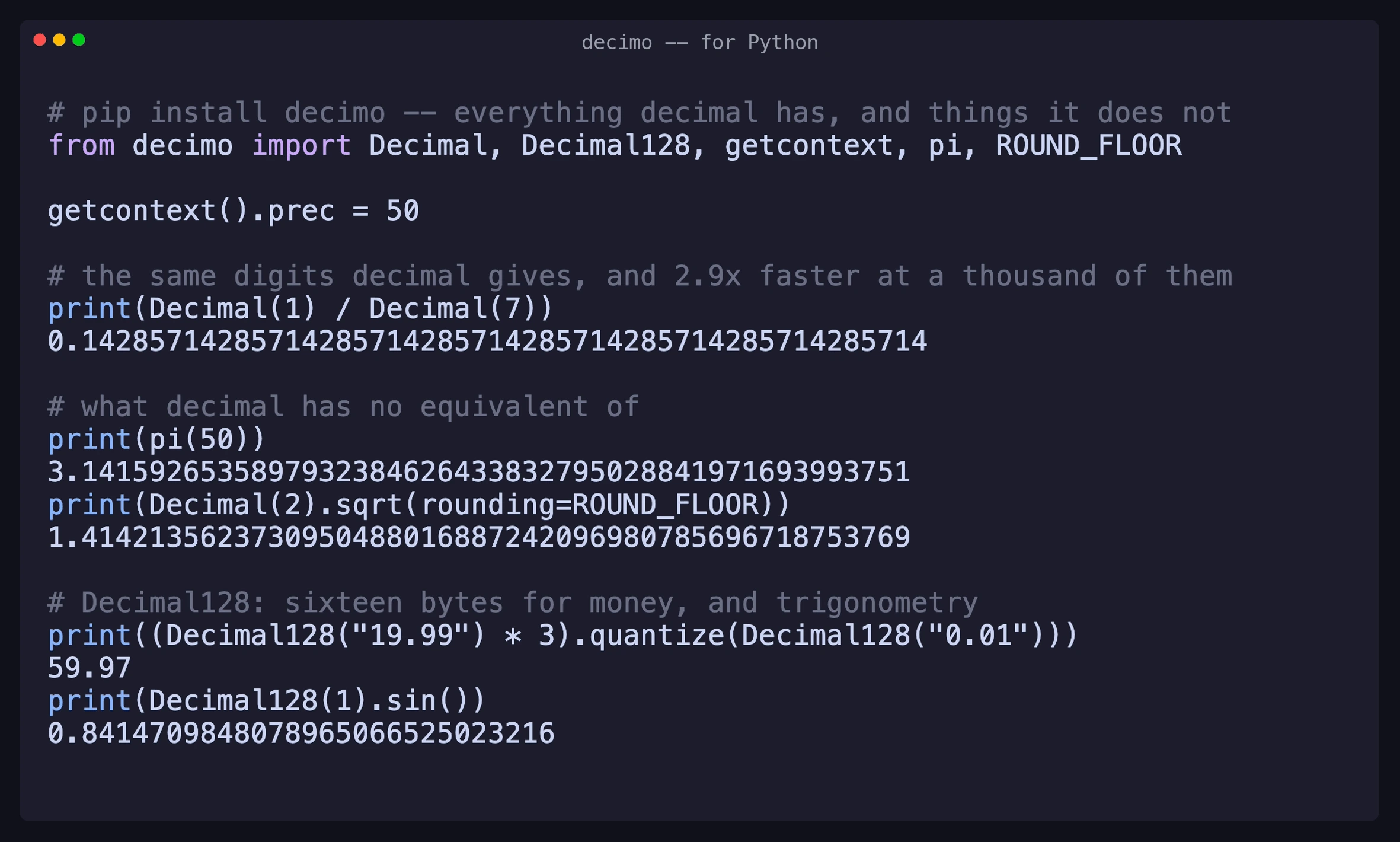
Everything decimal has, and things it does not
The Mojo library is also compiled into a Python extension and published on PyPI,
where it stands in for the standard library’s decimal. Change one import and
a decimal program keeps working:
# from decimal import Decimal, getcontext
from decimo import Decimal, getcontext

getcontext().prec = 50
print(Decimal(1) / Decimal(7))
# 0.14285714285714285714285714285714285714285714285714
The two agree digit for digit. The test suite checks every operation against
the standard library rather than against a table of expected strings, so
“agrees with decimal” is measured rather than claimed.
Nothing is missing: every method decimal.Decimal has, decimo.Decimal has
too. And it goes further. pi() and e() are there, which decimal has
neither of. sqrt, exp, ln and log10 take a rounding= argument, where
decimal ignores the context mode for those and always rounds half to even.
Decimal128 brings trigonometry, cbrt, root and the IEEE 754 interchange
bytes with it. And it is faster once the numbers are large — 2.9x at a
thousand digits — 20-25% behind on small ones, where what is left is the cost
of the Python call rather than the arithmetic.
Where it is not a drop-in it refuses rather than answers differently: no NaN
or infinity, no ROUND_05UP, no signals or traps, and one context per process
rather than per thread. See python/README.md for the
full list with the reasoning, and the
Python quick start below for a taste.
TOML parser
This repository includes a built-in TOML parser
(decimo.toml), a lightweight pure-Mojo implementation supporting TOML v1.0. It
parses configuration files and test data, supporting basic types, arrays, and
nested tables. While created for Decimo’s testing framework, it offers
general-purpose structured data parsing with a clean, simple API.
Installation
Install Decimo library for Mojo projects
Decimo is available in the modular-community
https://repo.prefix.dev/modular-community package repository. To access this
repository, add it to your channels list in your pixi.toml file:
channels = ["https://conda.modular.com/max", "https://repo.prefix.dev/modular-community", "conda-forge"]
Then, you can install Decimo using any of these methods:
-
From the
pixiCLI, run the commandpixi add decimo. This fetches the latest version and makes it immediately available for import. -
In the
mojoproject.tomlfile of your project, add the following dependency:decimo = ">=0.16.0, <0.17.0"Then run
pixi installto download and install the package. -
For the latest development version in the
mainbranch, clone this GitHub repository and build the package locally using the commandpixi run package.
Package versions and Mojo compatibility
The following table summarizes the package versions and their corresponding Mojo versions: | library | version | Mojo version | package manager | | ---------- | ------- | --------------- | --------------- | | `decimojo` | v0.1.0 | ==25.1 | magic | | `decimojo` | v0.2.0 | ==25.2 | magic | | `decimojo` | v0.3.0 | ==25.2 | magic | | `decimojo` | v0.3.1 | >=25.2, <25.4 | pixi | | `decimojo` | v0.4.x | ==25.4 | pixi | | `decimojo` | v0.5.0 | ==25.5 | pixi | | `decimojo` | v0.6.0 | ==0.25.7 | pixi | | `decimojo` | v0.7.0 | ==0.26.1 | pixi | | `decimo` | v0.8.0 | ==0.26.1 | pixi | | `decimo` | v0.9.0 | ==0.26.2 | pixi | | `decimo` | v0.10.0 | ==1.0.0b1 | pixi | | `decimo` | v0.11.0 | ==1.0.0b2 | pixi | | `decimo` | v0.12.0 | >=1.0.0, <1.1.0 | pixi | | `decimo` | v0.13.0 | >=1.0.0, <1.1.0 | pixi | | `decimo` | v0.14.0 | >=1.0.0, <1.1.0 | pixi | | `decimo` | v0.16.0 | >=1.1.0, <1.2.0 | pixi |Install CLI calculator
The decimo CLI is distributed via the
forfudan/tap Homebrew tap.
Pre-built binaries are available for macOS arm64 (Apple Silicon) and
Linux x86_64, and ship with the Mojo runtime libraries bundled — you do not
need Mojo or Pixi installed.
brew install forfudan/tap/decimo
decimo --version
Or tap once and use the bare formula name:
brew tap forfudan/tap
brew install decimo
To upgrade to a later release:
brew update && brew upgrade decimo
Install the Python package
pip install decimo
Wheels are built for macOS arm64 (macOS 11 and later) and for Linux on x86_64 and arm64 (glibc 2.35 and later), for CPython 3.13 and 3.14. Nothing else is needed — the Mojo runtime libraries travel inside the wheel. On any other platform, build from source with pixi:
git clone https://github.com/forfudan/decimo && cd decimo
pixi run -e py314 release        # or py313; the wheel lands in python/dist/
pip install python/dist/*.whl
Quick start
Library quick start
You can start using Decimo by importing the decimo module. An easy way to do
this is to import everything from the prelude module, which provides the most
commonly used types.
from decimo.prelude import *
This will import the following types or aliases into your namespace:
BigInt(and its aliasBInt): An arbitrary-precision signed integer type, equivalent to Python’sint.BigDecimal(and its aliasesBDec,Decimal): An arbitrary-precision decimal type, equivalent to Python’sdecimal.Decimal.BigFloat(and its aliasBFlt): An arbitrary-precision binary floating-point type, equivalent to MPFR’smpfr_t.Decimal128(and its aliasDec128): A 128-bit fixed-precision decimal type.RoundingMode: An enumeration for rounding modes.ROUND_DOWN,ROUND_HALF_UP,ROUND_HALF_EVEN,ROUND_UP,ROUND_CEILING,ROUND_FLOOR: Constants for common rounding modes.
BigDecimal — arbitrary precision, and how to set it
Here are some examples showcasing the arbitrary-precision feature of the `BigDecimal` (`Decimal`) type. For some mathematical operations, the default precision (number of significant digits) is set to `28`. You can change the precision by passing the `precision` argument to the function. This default precision will be configurable globally in future when Mojo supports global variables. ```mojo from decimo.prelude import * def main() raises: var a = BigDecimal("123456789.123456789") var b = Decimal("1234.56789") # Alias of BigDecimal # === Basic Arithmetic === # print(a + b) # 123458023.691346789 print(a - b) # 123455554.555566789 print(a * b) # 152415787654.32099750190521 print(a.true_divide(b + 1)) # 99919.06565608207008357913866 # === Exponential Functions === # print(a.sqrt(precision=80)) # 11111.111066111110969430554981749302328338130654689094538188579359566416821203641 print(a.cbrt(precision=80)) # 497.93385938415242742001134219007635925452951248903093962731782327785111102410518 print(a.root(b, precision=80)) # 1.0152058862996527138602610522640944903320735973237537866713119992581006582644107 print(a.power(b, precision=80)) # 3.3463611024190802340238135400789468682196324482030786573104956727660098625641520E+9989 print(a.exp(precision=80)) # 1.8612755889649587035842377856492201091251654136588338983610243887893287518637652E+53616602 print(a.log(b, precision=80)) # 2.6173300266565482999078843564152939771708486260101032293924082259819624360226238 print(a.ln(precision=80)) # 18.631401767168018032693933348296537542797015174553735308351756611901741276655161 # === Trigonometric Functions === # print(a.sin(precision=200)) # 0.99985093087193092464780008002600992896256609588456 # 91036188395766389946401881352599352354527727927177 # 79589259132243649550891532070326452232864052771477 # 31418817041042336608522984511928095747763538486886 print(b.cos(precision=1000)) # -0.9969577603867772005841841569997528013669868536239849713029893885930748434064450375775817720425329394 # 9756020177557431933434791661179643984869397089102223199519409695771607230176923201147218218258755323 # 7563476302904118661729889931783126826250691820526961290122532541861737355873869924820906724540889765 # 5940445990824482174517106016800118438405307801022739336016834311018727787337447844118359555063575166 # 5092352912854884589824773945355279792977596081915868398143592738704592059567683083454055626123436523 # 6998108941189617922049864138929932713499431655377552668020889456390832876383147018828166124313166286 # 6004871998201597316078894718748251490628361253685772937806895692619597915005978762245497623003811386 # 0913693867838452088431084666963414694032898497700907783878500297536425463212578556546527017688874265 # 0785862902484462361413598747384083001036443681873292719322642381945064144026145428927304407689433744 # 5821277763016669042385158254006302666602333649775547203560187716156055524418512492782302125286330865 # === Internal representation of the number === # ( Decimal( "3.141592653589793238462643383279502884197169399375105820974944" ).power(2, precision=60) ).print_internal_representation() # Internal Representation Details of BigDecimal # ---------------------------------------------- # number: 9.8696044010893586188344909998 # 761511353136994072407906264133 # 5 # coefficient: 986960440108935861883449099987 # 615113531369940724079062641335 # negative: False # scale: 59 # word 0: 940724079062641335 # word 1: 99987615113531369 # word 2: 440108935861883449 # word 3: 986960 # ---------------------------------------------- ```BigInt — arbitrary-precision signed integers
A quick tour of the main methods of the `BigInt` (`BInt`) type. ```mojo from decimo.prelude import * def main() raises: # === Construction === var a = BigInt("12345678901234567890") # From string var b = BigInt(12345) # From integer var c = BInt("1991_10,18") # From string with separators and spaces print(a, b, c) # === Basic Arithmetic === print(a + b) # Addition: 12345678901234580235 print(a - b) # Subtraction: 12345678901234555545 print(a * b) # Multiplication: 152407406035740740602050 # === Division Operations === print(a // b) # Floor division: 1000054994024671 print(a.truncate_divide(b)) # Truncate division: 1000054994024671 print(a % b) # Modulo: 4395 # === Power Operation === print(BigInt(2).power(10)) # Power: 1024 print(BigInt(2) ** 10) # Power (using ** operator): 1024 # === Comparison === print(a > b) # Greater than: True print(a == BigInt("12345678901234567890")) # Equality: True print(a.is_zero()) # Check for zero: False # === Type Conversions === print(String(a)) # To string: "12345678901234567890" # === Sign Handling === print(-a) # Negation: -12345678901234567890 print( abs(BigInt("-12345678901234567890")) ) # Absolute value: 12345678901234567890 print(a.is_negative()) # Check if negative: False # === Extremely large numbers === # 3600 digits // 1800 digits print(BigInt("123456789" * 400) // BigInt("987654321" * 200)) # === Greatest common divisor === print(a.gcd(b)) # Greatest common divisor: 15 print(a.gcd(c)) # Greatest common divisor: 6 ```BigFloat — binary floating point, to as many bits as you ask
A quick tour of the `BigFloat` (`BFlt`) type. The precision is a number of bits and travels with each value, so 53 of them is what a `Float64` holds and 200 is what no machine type holds. Every operation below is correctly rounded. ```mojo import decimo.bigfloat.constants as bigfloat_constants import decimo.bigfloat.trigonometric as bigfloat_trigonometric from decimo.prelude import * def main() raises: # === Construction: the precision is in bits, and is per value === var a = BigFloat.from_string("1.1", 53) # What a Float64 holds var b = BFlt.from_string("1.1", 200) # 200 bits of it print(a.to_string(), b.to_string(20)) # 1.1000000000000001 1.1000000000000000000 # === The four operations, each correctly rounded === var third = BigFloat.from_string("1", 200) / BigFloat.from_string("3", 200) print(third.to_string(20)) # 0.33333333333333333333 print((a + a).to_string(), (b * b).to_string(20)) # 2.2000000000000002 1.2100000000000000000 # === Square root, logarithm, exponential, power === var two = BigFloat.from_string("2", 200) print(two.sqrt().to_string(20)) # 1.4142135623730950488 print(two.ln().to_string(20)) # 0.69314718055994530942 print(two.exp().to_string(20)) # 7.3890560989306502272 print(two.power(BigFloat.from_string("0.5", 200)).to_string(20)) # 1.4142135623730950488 # === Pi and the circular functions, at the width you ask for === var pi = bigfloat_constants.pi(200) print(pi.to_string(20)) # 3.1415926535897932385 print(bigfloat_trigonometric.sin(pi / two, 200).to_string(20)) # 1 # === Seven rounding modes, and the neighbours of a value === print(two.sqrt().to_string(5, ROUND_DOWN)) # 1.4142 print(two.sqrt().to_string(5, ROUND_UP)) # 1.4143 print(a.next_plus(53).to_string()) # 1.1000000000000003 print(a.next_minus(53).to_string()) # 1.0999999999999999 # === The classes IEEE 754 asks for === print(BigFloat.infinity(53).number_class()) # +Infinity print(BigFloat.nan(53).is_nan()) # True ```Rational — exact fractions, with nothing rounded
A quick tour of the `Rational` (`Frac`) type. It is a pair of `BigInt` kept in lowest terms, so a third is a third and stays one however long you compute with it. Rounding happens only where you ask for it. ```mojo from std.math import ceil, floor from decimo import Frac, Rational from decimo.prelude import * def main() raises: # === Construction === var a = Rational("3/7") # From a ratio of two literals var b = Rational("1.5") # Read exactly: 3/2 var c = Rational(BigInt(22), BigInt(-8)) # Reduced and signed: -11/4 print(a, b, c) # 3/7 3/2 -11/4 # === Exact arithmetic === print(Rational("1/3") + Rational("1/6")) # 1/2 print(a * b) # 9/14 print(a / b) # 2/7 print(Rational("1/3") ** 5) # 1/243 # === Nothing rounds, so the thirds come back whole === print(Rational("1/3") * Rational(BigInt(3)) == Rational.one()) # True # === Comparison === print(a < b, a == Rational("6/14")) # True True # === Rounding, where you ask for it === print(round(Rational("7/2")), round(Rational("-7/2"))) # 4 -4 print(round(Rational("22/7"), 4)) # 31429/10000 print(floor(Rational("7/2")), ceil(Rational("7/2"))) # 3 4 # === Conversions === print(Rational("22/7").to_bigdecimal(30)) # 3.14285714285714285714285714286 print(Rational(BigDecimal("0.125"))) # 1/8 print(Rational("22/7").to_float()) # 3.142857142857143 # === The closest value with a denominator you can live with === print( Rational(BigDecimal("3.141592653589793")).limit_denominator( BigInt(1000) ) ) # 355/113 ```Decimal128 — a fixed 128-bit decimal
A quick tour of the main methods of the `Decimal128` (`Dec128`) type. ```mojo from decimo.prelude import * def main() raises: # === Construction === # Decimal128 and Dec128 are aliases var a = Decimal128("123.45") # From string var b = Decimal128(123) # From integer var c = Dec128(123, 2) # Integer with scale (1.23) var d = Dec128.from_float_scalar(3.14159) # From floating-point # === Basic Arithmetic === print(a + b) # Addition: 246.45 print(a - b) # Subtraction: 0.45 print(a * b) # Multiplication: 15184.35 print(a / b) # Division: 1.0036585365853658536585365854 # === Rounding & Precision === print(a.round(1)) # Round to 1 decimal place, half to even: 123.4 print(a.quantize(Dec128("0.01"))) # Format to 2 decimal places: 123.45 print(a.round(0, RoundingMode.ROUND_DOWN)) # Round down to integer: 123 # === Comparison === print(a > b) # Greater than: True print(a == Dec128("123.45")) # Equality: True print(a.is_zero()) # Check for zero: False print(Dec128("0").is_zero()) # Check for zero: True # === Type Conversions === print(Float64(a)) # To float: 123.45 print(a.to_int()) # To integer: 123 print(a.to_string()) # To string: "123.45" print(a.coefficient()) # Get coefficient: 12345 print(a.scale()) # Get scale: 2 # === Mathematical Functions === print(Dec128("2").sqrt()) # Square root: 1.4142135623730950488016887242 print(Dec128("100").root(3)) # Cube root: 4.6415888336127788924100763509 print(Dec128("2.71828").ln()) # Natural log: 0.9999993273472820031578910055 print(Dec128("10").log10()) # Base-10 log: 1 print(Dec128("16").log(Dec128("2"))) # Log base 2: 4 print(Dec128("10").exp()) # e^10: 22026.465794806716516957900645 print(Dec128("2").power(10)) # Power: 1024 # === Sign Handling === print(-a) # Negation: -123.45 print(abs(Dec128("-123.45"))) # Absolute value: 123.45 print(Dec128("123.45").is_negative()) # Check if negative: False # === Special Values === print(Dec128.PI()) # π constant: 3.1415926535897932384626433833 print(Dec128.E()) # e constant: 2.7182818284590452353602874714 print(Dec128.ONE()) # Value 1: 1 print(Dec128.ZERO()) # Value 0: 0 print(Dec128.MAX()) # Maximum value: 79228162514264337593543950335 # === Convenience Methods === print(Dec128("123.400").is_integer()) # Check if integer: False print(a.number_of_significant_digits()) # Count significant digits: 5 print( Dec128("12.34").to_scientific_string() ) # Scientific notation: 1.234E+1 ```CLI quick start
For an interactive session, just type decimo:

A real session: ans, the : settings system, and inline settings
$ decimo
Decimo — an arbitrary-precision calculator 🔥
Type ? for help, : for settings, :q to quit.
Precision: 50. Rounding: ROUND_HALF_EVEN.
decimo> 2 ^ 10
1024
decimo> ans / 4
256
decimo> 1/7
0.14285714285714285714285714285714285714285714285714
decimo> :100
Current settings:
  Precision     : 100
  Scientific    : off
  Engineering   : off
  Pad           : off
  Delimiter     : (none)
  Rounding mode : ROUND_HALF_EVEN
decimo> pi
3.141592653589793238462643383279502884197169399375105820974944592307816406286208998628034825342117068
decimo> sqrt(e) / ln(10) + sin(-1.23) :200 e he delimiter _
-226.458_251_870_114_348_807_514_569_584_297_293_353_150_959_525_480_515_507_901_779_719_167_225_208_528_825_475_488_261_072_148_336_432_171_617_635_953_314_758_797_226_777_458_915_435_649_950_836_584_843_137_886_028_274_720_793_979_517_570_004_978_334_405_953_342_64E-3
decimo> :q
The REPL keeps the last result in ans, lets you define variables
(name = expr), and exposes settings via :-prefixed commands (e.g. :100 for
precision, :s for scientific, :d for ROUND_DOWN). Input is case-insensitive.
Quit with :q, exit, or Ctrl-D.
As an innovative feature, Decimo supports multiple settings in a single line.
They can either be global (persist across calculations) or local (apply only to
the current expression). In the example above, :200 e he delimiter _ means
“evaluate the expression with precision 200 (200), scientific notation with
engineering exponent (e), round half to even (he), and use _ as the digit
delimiter in the output (delimiter _)”. The settings apply only to the current
expression and do not affect subsequent calculations.
For one-shot evaluation, pass an expression on the command line, pipe it via stdin, or read from a file:
$ decimo "sqrt(2)" -P 30
1.41421356237309504880168872421

$ echo "1/3" | decimo -P 50
0.33333333333333333333333333333333333333333333333333

$ decimo -F expressions.dm -P 80
Useful flags: -P N (precision), -R MODE (rounding), -S / -E (scientific
/ engineering), --pad, --delimiter, --completions {bash,zsh,fish}. Run
decimo --help for the full list.
Python quick start
Everything a decimal program normally touches is there, under the same names:
from decimo import Decimal, Decimal128, getcontext, localcontext, ROUND_FLOOR

getcontext().prec = 28

# The operators, the context, and the methods, as in `decimal`.
Decimal("0.1") + Decimal("0.2")          # 0.3, exactly
Decimal(1) / Decimal(7)                  # to the context precision
Decimal("2.675").quantize(Decimal("0.01"))
divmod(Decimal(17), Decimal(5))          # (3, 2)

# A context you can compute in, without touching the global one.
with localcontext(prec=50):
    print(Decimal(2).sqrt())

# Three things `decimal` does not have.
import decimo
decimo.pi(1000)                          # Chudnovsky with binary splitting
decimo.e(50)
Decimal(2).sqrt(rounding=ROUND_FLOOR)    # and exp, ln, log10, correctly rounded

# The fixed-width type for money: 16 bytes that own nothing.
price = Decimal128("19.99")
(price * 3).quantize(Decimal128("0.01"))  # 59.97
A mixed expression settles in the wider type — Decimal128 + Decimal is a
Decimal, either way round — and the hashes of Decimal, Decimal128,
int, float and decimal.Decimal all agree, so the five are
interchangeable as dictionary keys.
What decimo refuses rather than answering differently: NaN and infinity,
ROUND_05UP, signals and traps, and one context per process rather than per
thread. The full list, with the reasoning, is in
python/README.md.
Objective
Financial calculations and data analysis require precise decimal arithmetic that floating-point numbers cannot reliably provide. As someone working in finance and credit risk model validation, I needed a dependable correctly-rounded, fixed-precision numeric type when migrating my personal projects from Python to Mojo.
Since Mojo currently lacks a native Decimal type in its standard library, I decided to create my own implementation to fill that gap.
This project draws inspiration from several established decimal implementations
and documentation, e.g.,
Python built-in Decimal type,
Rust rust_decimal crate,
Microsoft’s Decimal implementation,
General Decimal Arithmetic Specification,
etc. Many thanks to these predecessors for their contributions and their
commitment to open knowledge sharing.
Status
Rome wasn’t built in a day. Decimo is currently under active development. It has successfully progressed through the “make it work” phase and the “make it right”, and is now well into the “make it fast” phase.
The BigInt type is fully implemented and optimized. It is measured against
GMP, timed in C, rather than against CPython’s int, which is reached through
the interpreter and so loses on call overhead before the arithmetic starts.
Bug reports and feature requests are welcome! If you encounter issues, please file them here.
Project structure
The source tree
```text decimo/ ├── src/ # All source code │ ├── decimo/ # Core library (mojo pre-compiled package) │ │ ├── bigdecimal/ # Arbitrary-precision decimal (Decimal) │ │ ├── bigint/ # Arbitrary-precision signed integer (BigInt) │ │ ├── bigint10/ # Base-10 signed integer (BigInt10) │ │ ├── biguint/ # Base-10 unsigned integer (BigUInt) │ │ ├── bigfloat/ # Arbitrary-precision binary float │ │ ├── mpf/ # The same in MPFR, outside the public API │ │ ├── rational/ # Exact rational number (Rational) │ │ ├── decimal128/ # 128-bit fixed-precision decimal (Dec128) │ │ ├── expression/ # Expression engine behind `decimo.eval()` │ │ │ ├── tokenizer.mojo # Lexer: expression → tokens │ │ │ ├── parser.mojo # Shunting-yard: infix → RPN │ │ │ └── evaluator.mojo # RPN evaluator using Decimal │ │ ├── numerals/ # Numeral systems (e.g. Chinese numerals) │ │ ├── toml/ # TOML parser (decimo.toml) │ │ └── ... # Shared utilities (str, errors, rounding) │ └── cli/ # CLI calculator application │ ├── main.mojo # Entry point (ArgMojo CLI) │ ├── limo/ # Line editor used by the REPL │ └── calculator/ # Presentation layer (display, io, repl, settings) ├── python/ # The library packaged for Python (PyPI: decimo) │ ├── decimo_module.mojo # The Python extension, written in Mojo │ ├── src/decimo/ # The `decimo` Python package around it │ └── tests/ # Checked against the standard library's `decimal` ├── tests/ # Unit tests (one subfolder per module) │ ├── bigdecimal/ │ ├── bigint/ │ ├── biguint/ │ ├── decimal128/ │ ├── expression/ # Expression engine tests │ ├── numerals/ # Numeral system tests │ ├── cli/ # CLI calculator tests │ └── toml/ ├── benches/ # Benchmarks (one subfolder per module) ├── docs/ # Documentation and design notes └── pixi.toml # Project configuration and tasks ``` `src/decimo/` is a Mojo package — it is compiled with `mojo precompile` and can be imported by external projects. The expression engine (`decimo.expression`), the numeral systems (`decimo.numerals`), and the TOML parser (`decimo.toml`) are included as subpackages. `src/cli/` is an application that consumes the `decimo` package and compiles to a standalone binary via `mojo build`. `python/` compiles the same package into a CPython extension and wraps it in a Python package, and is what `pip install decimo` fetches.Tests and benches
After cloning the repo onto your local disk, you can:
- Use
pixi run testto run all tests, orpixi run test <suite>for one suite (pixi run test --listshows them). - Use
pixi run testclito run CLI calculator tests. - Use
pixi run testpyto build the Python extension and run its tests against the standard library’sdecimal. - Use
pixi run benchto run benchmarks. - Use
pixi run benchdocto regenerate docs/benchmarks.md against libmpdec, GMP, CPython and MPFR. Needsmpdecimalandgmpinstalled for the C comparisons; the reference libraries for thepi()table live in the optionalbenchdocenvironment (pixi install -e benchdoc). - Use
pixi run buildclito compile the CLI calculator to a./decimobinary. - Use
pixi run organize_importsto group, sort and de-duplicate the imports in every.mojofile: four blocks separated by a blank line — the Mojo standard library, third-party packages,decimoitself, and modules reached through-I.--checkis what the pre-commit hook runs. A file whose import block holds a comment is left alone and named as skipped;scripts/organize_mojo_imports.py’s docstring says why, and why--remove-unusedis opt-in. - Use
pixi run check_import_fixed_pointafter changing the organizer or the Mojo version: it asserts that the organizer andmojo formatdo not undo each other’s work. - Use
pixi run docexamplesto run every Mojo example in the documentation and check that it prints what its comment says. A comment that describes the result in prose is left alone; one that names a value is compared with the line that print produced. Each block is a separate compile, so this takes minutes and is not part ofpixi run test. - Use
pixi run one <file.mojo>to run a single file – a sweep against a reference, a measurement, a probe – against the working tree.mojo runputs the file’s own directory on the import path ahead of-I src, so adecimo.mojocleft beside the file would silently stand in for the source; this clears those first.
Citation
If you find Decimo useful, consider listing it in your citations.
@software{Zhu.2026,
    author       = {Zhu, Yuhao},
    year         = {2026},
    title        = {Decimo: An arbitrary-precision integer and decimal library for Mojo},
    url          = {https://github.com/forfudan/decimo},
    version      = {0.16.0},
    note         = {Computer Software}
}
License
This repository and its contributions are licensed under the Apache License v2.0.
The MPF type optionally uses the
GNU MPFR Library (LGPLv3+) and
GMP (LGPLv3+ or GPLv2+) at runtime. Decimo does not
include or distribute any MPFR/GMP source code or binaries — they are loaded via
dlopen only if the user has independently installed them. All other Decimo
types work without any external dependencies. See the NOTICE file
for details.
-
The
Dec128type can represent values with up to 29 significant digits and a maximum of 28 digits after the decimal point. When a value exceeds the maximum representable value (2^96 - 1), Decimo either raises an error or rounds the value to fit within these constraints. For example, the significant digits of8.8888888888888888888888888888(29 eights total with 28 after the decimal point) exceeds the maximum representable value (2^96 - 1) and is automatically rounded to8.888888888888888888888888889(28 eights total with 27 after the decimal point). Decimo’sDec128type is similar toSystem.Decimal(C#/.NET),rust_decimalin Rust,DECIMAL/NUMERICin SQL Server, etc. [^bigint]: TheBigIntimplementation uses a base-2^64 representation with a little-endian format, where the least significant word is stored at index 0. Each word is aUInt64, allowing for efficient storage and arithmetic operations on large integers. This design choice optimizes performance for binary computations while still supporting arbitrary precision. [^auxiliary]: The auxiliary types include a base-10 arbitrary-precision signed integer type (BigInt10) and a base-10 arbitrary-precision unsigned integer type (BigUInt) supporting unlimited digits[^bigint10].BigUIntis used as the internal representation forBigInt10andDecimal. [^bigint10]: The BigInt10 implementation uses a base-10 representation for users (maintaining decimal semantics), while internally using an optimized base-10^18 storage system for efficient calculations. This approach balances human-readable decimal operations with high-performance computing. It provides both floor division (round toward negative infinity) and truncate division (round toward zero) semantics, enabling precise handling of division operations with correct mathematical behavior regardless of operand signs. [^arbitrary]: Built on theBigUIntimplementation, Decimal supports arbitrary precision for both the integer and fractional parts, similar todecimalandmpmathin Python,java.math.BigDecimalin Java, etc. ↩